Saturday, September 22, 2012

A Conversation with Artist Teklit Zecarias

Part II


 Teklit at the Eritrean Festival 2012, Washington, D.C.
(picture courtesy of Yared Tseggai)


Issayas: One of your painting is on the Eritrean postage stamps. Would you tell us more about it? What is the title of the painting? What year, etc?

Teklit: In 2001, for the 10th anniversary of Eritrean independence, there was an art competition for postal stamp; and three artists (Martha, Petros and I) won. The title of my art work is Hagerey Shlematey (My County, My Jewelry); the painting shows that, during the war with weyan (the ruling elite in Ethiopia), Eritrean mothers and sisters placing their gold, even their wedding rings, on the top of the Eritrean flag. The role of Eritrean women during the war and peace is remarkable, which has not been done in other countries.


Hagerey Shlematey(My Country, My Jewelery)

 
 Teklit, Petros and Martha winners  of the postal art competition, 2001


Issayas: Have you won other awards?

Teklit: In 2000, during the first Eritrean Students Festival, I was awarded for first place. The title of the work was Hidri (promise). In 2004, in my school Lipscomb University, I was awarded for first place and honored.


1st prize award at Lipscomb University

Issayas; You also studied graphic design? What is graphic design?

Teklit: I have not done a lot in graphic design, but for me graphic design is just like other kinds of art, has the same Principles of art. The difference is just that you have to do it in computer using graphic software.

Issayas: In our discussion, you mentioned that you know and did internship with Nadia Biasolo. How did your internship with Nadia (owner of Alkemya in Asmara. check my blog on Alkemya) helped you in shaping your artistic world? What kinds of things were you doing during your internship?          

Teklit: I started working with Nadia Biasolo in 1995. We (two friends and I)  were drawing murals on walls when we met Nadia. She invited us to her house. Then we started working and learning with her as interns. We kept working with Nadia  and going to her studio until 2002. I have learned a lot from her. At that time, all the ideas and plans was her's, we were just giving her a hand, following her instruction on projects that she had. Yes it does help me a lot. I understand that art is not just drawing and painting only. If one artist has an open mind to learn new things he/she could do different kind of art, because  art has the same principle. Nadia has a lot of experience on her profession; her works of art has great quality. I was very impressed by the process of her work. She start her work from raw material (cotton) then she finishes her final product with decoration of art. I have learned discipline and patience from Nadia, when you do an art work. I did painting on  walls and on  products of cotton or crafts. She is a wonderful friend and a teacher for me.

Issayas: Teklit, you're right. Nadia is very creative. Beside the products that they do at Alkeyma, I saw etro (big Eritrean traditional clay jar for traditional drinks) as a light stand in her house. Well, Teklit thank you for your time and this conversation.

Teklit: Thank you.

More pictures of Teklit's paintings. Note: Pictures courtesy of Teklit.


Tuesday, September 18, 2012

A Conversation with Artist Teklit Zecarias


Teklit Zecarias at 2012 Eritrean Festival, Washington, D.C.


Part I


Issayas: Briefly, tell us about yourself?

Teklit: I was born in the ancient nation of Eritrea, located along the Red Sea in East Africa, in 1980. At the age of one, my family moved from their rural home to Asmara. I started drawing when I was young. I would use one side of my school book for schoolwork and the other side for drawing; I also loved modifying different shapes out of recycled materials and clay. I was 15 when I went to my first art training in the summer of 1995. Most of our teachers were artists who fought for Eritrea’s independence. As soldiers, during the war, they kept their love for art. This made me appreciate all the talent they had to offer and inspired me to keep art in my life, even during hard times. That training compelled me to seek furtherart education. I studied art, in 1997, with three Chinese Professors in Asmara Art School. And once my family migrated to the U.S., I took what I learned there to receive my BA in studio and graphic design, from Lipscomb University, in Nashville, Tennessee.

Issayas: What is art?

Teklit: Art is everything, especially if we are talking about visual arts. It studies line, form, shape, composition, proportion, perspective, color, value (dark and light), texture, expression and more. An art work could be created using a reference or just from imagination. Art can be done in many different ways, for example: painting, sculpture, design, music, novel, poem, and more, in which individuals express their vision using their unique artistic talent. Some arts may require some special talent or training. However, every human being has some artistic potential. Therefore, most of the arts are done by majority of the population. For instance, if we look around us, we are surrounded by work of arts everywhere: look at your clothes, shoes, furniture etc.; all items are somehow created by an individual using some type of art.


Eritrean Festival, DC
(pictures are courtesy of Yared Tseggai)

Issayas: What is the importance of art in Eritrean society?

Teklit: Art is very crucial for the Eritrean society. I cannot imagine the civilization we have now, would be possible without the participation of the artists and artisans who had the vision and ability to design and create the arts that makes Eritrea what it is today. Art was essential to the ancient civilization of Eritrea. Unfortunately, we have not continued progress on our art for the past many centuries, as we should have like the western society. There are various reasons for the loss our ancient civilization, however, we should not take for granted the knowledge that our ancestors left for us. Seeing what our world has reached now is only the continuation of the ancient civilizations; artists today imitating their ideas to create new forms of art. Art in Eritrea plays a great role on the development of the country, documenting present and past history, entertaining and educating the people, and harmonizing the society.  

Issayas: As a painter, what does painting mean to you?

Teklit: Painting gives me a chance to see nature deeply. Understanding the basic principles of art helps me to analyze things visually. Even when I am not  painting on canvas, I always feel like I am painting when I see something which impresses me. My goal is always to express my internal feeling on canvas. My plan is usually to try to simplify my painting, avoiding too many details by using few and effective brush strokes and the right values of colors. I do this by squinting my eyes to view the big shapes on the object. I love the depth of the shadow and the effects of light, the way they create three dimensional shapes on the painting.

For more on the works of Teklit Zecarias, check out :

http://www.lipscomb.edu/socialwork/Filter/Item/0/12492

http://www.teklitzecarias.com

Next,  part II

Monday, September 10, 2012

A conversation with musician Yonas Ghirmay

Part three

Issayas: Did you get a chance to listen to Robel's group sampler? If you did, what do you think of it?

Yonas: Yes I did and I had great time listening to it. It is very different than other techno- like productions in the past. Because some of the component of the composition did not frustrate my expectation. In other words, a composer would introduce an idea or ideas and then develops that simple idea to become something that none of us can imagine. In that way listeners are anticipating internally in their mind and souls their own musical process to tune up the end result. Let me give you another perspective. In mathematics we see a lot questions driven to solve for X or the unknown value. You are given the value for A & B, which means that you can solve for X or C. By the same analogy, if you mention that Geez music to be identified with your production or composition, then we need to define what is and what is not. I can see that every Habesha singing style can trace it inception from Geez. Geez is a house hold name and is a basis for our culture including making  the parameters of literature, singing styles and vocal styles.

If one is claiming that their product has Geez zeima element in it and when one of the above mentioned elements are none existent in your work, then frustration is inevitable. First and foremost, Geez is performed or is intended for an acapella style of singing,which means that it is not accompanied with musical instruments except with those musical instruments that can not produce melody or harmony such as, sistra, kebero and mekomia. Robel's music does not incorporate some of these musical elements to give us some sense of Geez. To give you an example, the so called "Chinese food" in the United States is not same  dish as in mainland China, but it's a brilliant idea the way it's marketed to Americans' taste and be able to generate so much money in every corner of entire cities in America. From the point of creation of new audience and market in  the future, it is very wise to tailor one's music to be heard by wider range of demographic or international ear. But the question remains the same, there is a prior knowledge of what Geez music should sound like and it is very difficult to alter that perception by just giving it the name Geez and not incorporating it basic identity.  Does it mean that Geez needs to remain to the same with out any change and people must study it the way it was done in the 4th century? In those days a young boy is trained from age 7 in the style of repeat after me kind of pedagogy, which took fo ever to master the entire book Dugga. If Geez served as vocal music in those days, the questions that we need to ask  are: can we arrange Geez zeima to modern instruments instead of singing in unison (when the entire group is singing the same melody with out any harmony)? Can we arrange it to be sung in counter point style of singing whereby different parts or a section of the group is singing different part of the music at different pitch level as well as different times instead of singing at the same time to the texture and volume of the composition? How about counterpoint dynamics where by the introduction of the music is very soft to express some important values of the  lyric and to give it gradually increase in volume and energy to highlight a new section of the composition?

Issayas: Thank you for your time.

Yonas: Don't mention it.


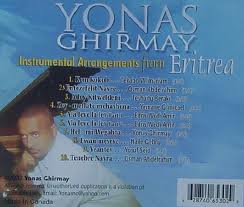
Back cover of Yonas' CD entitled "Instrumental Arrangements from Eritrea"

NOTE:  In 2003, I bought a CD entitled, “Instrumental Arrangement From Eritrea” in Washington, DC. The CD was produced by Yonas Ghirmay in 2002. I liked it the moment I heard it because it was different. In April 2004, Melba Williams, a former Stanford University film masters degree student,
asked me if I had Eritrean CDs that she wanted to use for her film dissertation (MEND). One of the CDs I gave her was Yonas Ghirmay’s. She liked the #1 score (Kem Kokeb.) on the CD. She contacted Yonas to give her permission to use the score in her film. Yonas was gracious enough to let her use it. Since then, I've also used his music for my documentary films.

Back then, I interviewed Yonas for Shaebia.org. Also then, I asked Dr. Cynthia Tse Kimberlin, a musicologist, to comment on the CD. As usual, her response was positive. I thank her for that. Below is Dr. Cynthia’s review.

Instrumental Arrangements from Eritrea.
©2002 Yonas Ghirmay. Made in Canada 

Reviewed by Cynthia Tse Kimberlin, Ph.D.

1974 was a watershed year in the Horn of Africa, a time in which major events sowed the seeds of an accelerated Diaspora movement. These migrations took place at a time when new technological advances were being made in transportation and communication and which Eritreans and Ethiopians have astutely exploited by creating their own networks in the form of virtual communities.  A result, these factors produced an environment of invigorated music creativity of which this CD is emblematic. Instrumental Arrangements from Eritrea contains music that is collaborative, transnational, and no longer bound by geography and language constraints.  As part of the Eritrean community in the New Orleans area, Executive Producer, composer and arranger Yonas Ghirmay and others like him are redefining music within the framework of the global community of music and music making. Most of the music selections on the CD are renditions of jazz using recognizable traditional melodies accompanied by Western instruments. The one exception is the use of the ‘ud played by Brian Prunka.  According to Prunka, “The 'ud (also known as the oud…is a musical instrument common to all Arab cultures. It is also an important part of the Turkish musical tradition and may have originated in Persia…”

A key factor in this recording is that the creative process retains strong elements of one’s ancestral roots that form the basis for ‘new compositions’.  What is distinctive about this music is that this is an approach not commonly practiced; that is, this instrumental ensemble does not accompany singing.

There are ten examples whose titles are given in transliteration with the musician’s name and include: Kem kobob, Entezefelit Nayre, Adey Kitweldeni, Zey – meflate mehashena, Ala leye la ley (Parts 1 and 2), Hel – mi Wegahta, Ewan meseye, Yeantey, and Tenebre Nayra. Musicians and the instruments they play are Yonas Ghirmay (piano), Brian Prunka (acoustic guitar and ‘ud), Matt Rhody (violin), Michael Jenner (saxophone), Michael Skinkus (percussion), Andy Wolf (double bass), and Jason Marsalis (drum set).

Yonas’ major strength is his bi-musicality. First, his music arrangements are a testament to his educational training in music composition at Loyola University in New Orleans where he gained greater knowledge and practice of various art and popular music forms. Second, not only is he knowledgeable in the music of Eritrea and Ethiopia, but as a former seminarian who trained to be a priest in the Ge’ez rite, he is also a practitioner of Ge’ez chant with a strong interest in preserving its tradition. He is acquainted with 30 to 40 ex-seminarians living in the USA who know from memory the Ge’ez liturgy and they formed a chapter, meet annually, and are devoted to this music. As a result Yonas is in the process of forming a national Ge’ez chorus and intends to produce a recording of this choral group.* 

This multi perspective towards music making is evident in this CD. According to Yonas “it contains a variety of arrangements of ethnic (folk music) and also modern. I totally avoided the use of electronic instrumentation. It is absolutely acoustic with the idea of me being in New Orleans; it has [that] ‘Gumbo’ flavor.”  (Feb 2, 2004). Although this music does not accompany singing, some of the music would be suitable for accompanying dance. Since Yonas’ solo piano composition found on track 7, Hel-mi Wegahta, possesses a style and mood so different from the rest of the examples, I would recommend that this composition, as an example of intercultural music,** be issued on a separate CD along with other examples of this nature.  This piece is based on a traditional melody, and it would be interesting to know from where the inspiration came to compose this piece.  Personally, the tracks having a special appeal for me are 5 - 9.  Tracks 5, 6, 7 and 9 primarily because their evolution can be clearly discerned in that musical ideas are developed from a basic core idea, and then expanded.

The cover layout and design features lead me to believe the CD is meant for the Eritrean communities worldwide. If it was intended to cultivate a broader based audience, the song titles could have been described and/or translated into English, and the sparse liner notes could have been expanded to accommodate listeners less familiar with the music. A brief description of each selection could have been given, as well as brief bios of the musicians. In addition, the listeners in general, and musicians in particular, would be interested in learning about the creative process taking place when these arrangements were being developed and which are based on essentially traditional melodies. Lastly, if Yonas continues to explore and capitalize on his strengths, with his penchant for exploring new avenues, he will bring forth a freshness and spontaneity that is long overdue.
                                                                  

Notes:

* For the chorus singing Ge’ez liturgy, instead of having the chorus sing a single melody in unison as  traditionally practiced in Ge’ez chant, Yonas has arranged some of the chants in four parts where the  various parts imitate each other at different pitch levels and interval sequences. This practice is   reminiscent of the music of German composer Johann Sebastian Bach’s (1685-1750)  counterpoint as  epitomized in his chorales, preludes, and fugues. Yonas says his approach to choral music may prove to  be a challenge for the untrained musician or individual trained to sing in Ge’ez.  Yet, he consciously incorporates new elements into a traditional musical practice so that it would appeal to a wider public  and that others might develop an interest in this genre of music.

**  For a definition of the term see the "Introduction" to Intercultural Music Volume 1 edited by Cynthia Tse  Kimberlin and Akin Euba. Centre for Intercultural Arts, London U.K. and Bayreuth African Studies Series, Bayreuth University: Bayreuth, Germany. 1995:2-5.  It can also be accessed  online at:

 http://www.music-research-inst.org/html/main/im_definition.htm
 

Saturday, August 25, 2012

A conversation with musician Yonas Ghirmay

Part two.


Yonas Ghirmay

Issayas:  Does our zeima has musical  notation? Could we even compare our traditional zeima notation with western musical  notation? If we could, how?

Yonas: I am assuming that by zeima you are referring to our church music. If it's, yes it does. However, for our conversation sake, let’s not use the word notation because it creates a problem. Musical  notation in western music indicates tone, time (measure), beat (beat value) etc., whereas in Geez zeima, it has similar intention and purpose. Loosely speaking, melekit in Geez is a hint that guides the chanter to remember the melody. It also indicates as to how long that particular melody should be held or sustained. In western notation a note carries definitive value and duration. For example, in 4/4 time a quarter note get one beat. We need to understand the following terminologies in the western concept: notes, pitch and duration. Notes are the symbols written on the staff that express the pitch and duration of a sound.  A  pitch is expressed by a note’s placement on the staff. When a note has fallen off the staff, it is placed on a ledger line. Duration depends on the note’s length (or “value”), which is specified by its color, stem, or flag(s). The length of a note will tell you how many beats it covers in a measure. The most common note lengths are: quarter note, half note and whole note.Therefore, I do not  want to suggest to anyone that melikket means notation. In fact I prefer to call it a sign.

In western music, notations are designed to represent the white and black keys of the keyboard and its construction is equally divided into 12 half steps which is known as well tempered system. Whereas Geez meleket are design to assist the chanter (Debter) to learn or help remember the short melodic patterns. Even though, in Geez zeima, we have three kinds of modes (scales) of styles of singing and most of the singing is governed under the style of GEEZ, ARARAY and EZILE. It cannot be represented as the equivalent of western musical system or key board. Therefore, the purpose and the use and the style of singing are not congruent and let us not use one term to substitute  for the other. It's like comparing apples and oranges. Western notation has its own set of challenges and short comings in representing other styles of music and rhythmic patterns. It is safe to say that western music have developed leaps and bound from the early medieval music to the modern music. If there is a need to draw a parallel between Geez meleket and western notations, it would be fair to compare Geez meleket to early western medieval music known as plainchant (Gregorian) music

Issayas: You were the first who told me about Abba Berhanemeskel's book. Abba Berhanemeskel argues that we need to formalize our traditional musical sign like western musical notation?  Do we need to formalize? If we do, why?

Yonas:  Abba Berhanemeskel is a unique musician and linguist and his book is a manifestation of all his hard work. It helps us as a guideline to lead the way and improve our understanding of music.  I bought the book immediately and started to read. If one claims to be musician, one must own this book as one’s musical bible especially when it comes to understanding our ethno-musicology and terminology in Eritrean and Geez music in general. This book have addressed all the rudiments of music in both Western and Eritrean traditional prespective in various levels and contrasts and compares music theory. For example, pentatonic scales versus western diatonic scales both in their construction and theoretical approaches and its further use in constructing of harmony. Traditional singing styles of zeima Geez both secular and sacred and their governing rules have not been shed to light before in this manner and detailed explanation. Furthermore, this book addresses so many topics as far as singing style is concerned whether traditional, secular or sacred and also examines that our musical tradition can not be misrepresented by western powers specially the governing body and theory behind western music. This is simply to say that western instruments and musical language can not truly represent our singing style because our scales are not represented in the western musical scale system. Abba Berhane's book dares musicians and engineers to come together to open up scholastic partnership to explore ways to design instruments that can truly play our style of music and singing style. In other words, if you try to play any traditional  Geez sacred music, you are out luck for the most part because the white and black key of a keyboard will not reproduce the intended sound. It means that Geez music in general is a very different animal  and must be handled with either human vocal chord or design one that can truly play it. Most Eritrean musicians do not seem to be interested to open up the above mention challenges that need urgent attention for upcoming younger generation,therefore, it is a call to better understand our heritage and musical language as a whole. Almost the entire book is the representation of the unadulterated original Eritrean culture rooted in Tigrigna terminology.  This magnificent book like what Abba Berhane wrote could not have been written by anyone else but him. It requires so much knowledge and research of a lifetime. I have learned so much and it is really a blessing to have Abba Berhane to provide us so much, which I can not put price tag behind it

Issayas:  Abba Berhanemeskel argues that no musical instruments were built to play zeima . Does it mean we need to come up with our own instrument as the Indians came up with the Sirtar?

Yonas: Yes. All western instruments are designed to produce what is needed in their culture. As time went by many modern instruments were invented. Lute, violin, 4 string guitar, harp, harpsichord , organ, synthesizer and so on.

Issayas:  The Holy Mass is divided into sections: Introductory rites, Liturgy of the Word, Liturgy of the Eucharist, Communion rite and the Concluding rite. Are different zeimas applied to the sections in our traditional Holy Mass ?

Yonas: All  Geez zeima  follow seasonal sequence. During the Lent, one can tell the melodies are different because it has a lots of lamentation and sorrow, which is similar to the minor scale in the western system.

Issayas:  I hear many Eritrean singers or musicians talk about "so and so sings in minor". What are they referring to when they say minor? Is minor the only reference to Tigrigrna music?

Yonas:  I heard the same comment that you're referring to  millions of times. And each time I hear it, it drives me crazy. It seems that minor is mislabeled as to mean genre. We can say this song is written in the minor key: of A minor or D minor. It just indicates what keys and what note are available to you. This is basically when you are playing in western musical concept and piano. In other words, in  western music, minor is associated with subdued or sad feeling  whereas, major is associated with happy or festive feeling. This phenomena is deeply rooted in western music than any other cultures, because some eastern European cultures write music in a minor key and it does not feel sad or depressive. As I have mentioned before western music and philosophy have a great deal of limitations to clearly define other non -western musical phenomenon.Tangential evidence for how nurture, rather than nature, forms our collective musical brains and ears comes from 18th-century mathematician Robert Smith, quoted in Ross Duffin's mind-opening book How Equal Temperament Ruined Harmony (and Why You Should Care). Smith is talking about something else we now take completely for granted (it's in the way pianos are tuned, and the way we hear most music today): the division of the octave into 12 equal semitones. Here's Smith, writing in 1759:

 The octave being always divided into five tones and two limmas [diatonic semitones]; by increasing the tones equally … the difference between the major and minor limma will be contracted to nothing, which … annihilates all the false consonances. But the harmony in this system of 12 semitones is extremely coarse and disagreeable.

To his ears, maybe. But we've become used to it over the past two and a half centuries, for better or worse. I bet Smith heard a minor third differently from us, too. As we noticed in the previous topic, the A Natural Minor scale contains the same notes as the C Major scale, with just a different starting note.  This is a very important property of the Natural Minor scale. Every Major scale has a relative Natural Minor scale, starting on its sixth note, which contains the same notes.  This means that music in a Natural Minor scale can be written on staff lines in the key signature of its relative Major scale without any accidentals. Some examples of equivalent Major and Natural Minor keys are shown below.  You can assume that when a minor key is referred to, it is the Natural Minor scale, unless one of the other minor scales is specifically mentioned.So how do you know when music is in a major key, or the related minor key?  The starting or ending chords in the song often give the best clues. Music in a major key has the characteristic major sound, and tends to use more of the related major chords of the scale (such as Cmaj, Fmaj and Gmaj in the C Major scale). Why does Handel's Water Music and The Beatles' 'Here Comes The Sun' sound happy, while Albinoni's Adagio and 'Eleanor Rigby' sound sad? Some might say it's because the first two are in major keys, while the
second two are in minor keys. But are the emotional associations of major and minor intrinsic to the notes themselves, or are they culturally imposed?

Many music psychologists suspect the latter, but a new study now suggests that there's something fundamentally similar about major or minor keys and the properties of happy or sad speech, respectively. Nigel Tufnell of spoof rock band Spinal Tap famously called D minor "the saddest of all keys". But are minor keys intrinsically sad? Neuroscientist Daniel Bowling and colleagues at Duke University in Durham, North Carolina, compared the sound spectra — the profiles of different acoustic frequencies – of speech with those in Western classical music and Finnish folk songs. They found that the spectra in major-key music are close to those  in excited speech, while the spectra of minor-key music are more similar to subdued speech. Most cultures share the same acoustic characteristics of happy or sad speech, the former being relatively fast and loud, and the latter slower and quieter. There's good reason to believe that music mimics some of these universal emotional behaviors, supplying a universal vocabulary that permits listeners sometimes to deduce the intended emotion in unfamiliar music. For example, Western listeners can judge fairly reliably — based largely on tempo — whether pieces of Kirghistan, Hindustani and Navajo Native American music were meant to be joyous or sad.

A study of the Mafa people of Cameroon, who had never heard Western music, also found that they could guess whether extracts were intended to be happy, sad or fearful. So although it's simplistic to suppose that all music is happy or sad, these crude universal indicators of emotion do seem to work across cultural boundaries. So is musical key another of these universal indicators, as Bowling's study suggests? The idea that the minor key is intrinsically anguished, while the major is joyful, is so deeply ingrained in Western listeners that many have deemed this to be a  natural principle of music. This notion was influentially argued by musicologist Deryck Cooke in his 1959 book The Language of Music. Cooke pointed out that musicians throughout the ages have used minor  keys for vocal music with an explicitly sad content, and major keys for happy lyrics. But he failed to acknowledge that this might simply be a matter of cultural convention rather than an innate property of the music. And when faced with the fact that some cultures, such as Spanish and Slavic, use minor keys for happy music, he offered the patronizing suggestion that such rustic people were inured to a hard life and didn't expect  to be happy. No such chauvinism afflicts the latest work from Bowling and colleagues. But their conclusions are still open to question. For one thing, they don't establish that people actually hear in music the characteristic acoustic features that they identify. Also, they assume that the ratios of frequencies sounded simultaneously in speech can be compared with the ratios of frequencies sounded sequentially in music.  And most troubling, major-type frequency ratios dominate the spectra of both excited and subdued speech, but merely less so in the latter case. This work also faces the problem that some cultures— including Europe before the Renaissance, not to mention the ancient Greeks — don't link minor keys to sadness. Western listeners sometimes misjudge the emotional quality of Javanese music that uses a scale with similarities to the minor mode yet is deemed happy by the musicians. So even if a fundamental sadness is present in the minor mode, it seems likely to be weak and easily over-written by acculturation. It's possible even in the Western idiom to write happy minor-key music — Van Morrison's 'Moondance', for example — or sad major-key music, such as Billie Holiday's 'No Good Man'. It seems too soon to conclude that minor keys give everyone the blues. New evidence for a musical phenomenon we've taken for granted for centuries: that the minor key is sadder than the major. Dido's Lament is audibly bleaker than Kylie's "I Should Be So Lucky" – although neither are as sad as the doleful monotone of the vuvuzelas that blared out from Bloemfontein on Sunday.

A scientist in Massachusetts thinks that she's discovered a link between the interval of a minor third (C major to E flat, say) and expressions of sadness in human speech. Meagan Curtis found in her study that the speech-melodies of actors' voices (the movement of pitch in their intonation) happened to encompass a minor third when they were asked to communicate sadness. And when listeners were played the same speech-melodies, short of the words, they accurately interpreted the actors' emotion. So which came first, the sad minor third in music or the sad minor third in speech? Have centuries of music in minor keys conditioned us to the sound of sadness, or has music through the ages drawn from the cadences of our speech and heightened its emotional power? There is another question, too: given that we can only hear a minor third as sad if we imagine the harmonic context around it (as an interval, it's the top half of a "happy" major triad, and is part of all major scales as well; D–F and A–C in C major, for example), is this phenomenon limited to western musical cultures and harmonic systems? Other languages and other musical cultures will surely have different expressions for emotional intensity – something Curtis's study can't tell us, as her sample was limited to American English. Besides which, the use of the minor key in any song or symphony is only one way to communicate sadness. I think what Curtis has discovered is more  to do with learned behavior than the revelation of a universal cultural or musical truth.

Next, last part

Wednesday, August 15, 2012

A Conversation with musician Yonas Ghirmay


Part One

Musician Yonas Ghirmay

Issayas:  Before we start, as you know, I use music from your CD to drive the "story" in my documentary. Also, as you know, I still bug you about your next music CD and hopefully your Ge'ez CD. I won't leave you alone until you produce them. For people who don't know you, would you tell us about yourself?

Yonas:  I was born and raised in Asmara. I went to La Salle where my first exposure to musical instruments came about. Even though, my knowledge was limited, I played guitar and keyboards. However, that limited knowledge became a great influence on me. There were other influences too. Osman Abdelrahim and Berket Mengistab were great influences. I used to know all the lyrics and songs of Osman when I was just a little boy. Also, Kaleb Temesgen and Woldegabir Temesgen were influences. I used to go to their house to watch them play. In 1986/7 I went to Sudan, where I was exposed to more music. In 1988 I went to Sweden. In Sweden, I was introduced to more genres: classic, pop, jazz etc. I also picked up the guitar. I wanted to know the secret of harmony. But everybody was keeping it as a secret. In 1991, I came to the US. First, I went to St. Louis, Missouri. From St. Louis, I went to Philadelphia where I enrolled at Temple University. From there, I went to Loyala University in New Orleans, Louisiana.  From New Orleans,my family and I moved to North Carolina where we currently reside.

Issayas:  What is Zeima? What are the different parts and their differences?

Yonas: Zema simply means to sing or to outline any kind of melodic patterns. Geez zema or Zema Geez is a sacred style of singing with enormous repertoire of oral tradition in Geez language. This master piece style of singing developed three different kinds of arrangements and devised to utilize them according to the traditional seasons of the church. These three different styles of singing are Araray, Ezle and Ge'ez.  The differences between the three styles, purposes, uses, and functions are very clear.  Some people would argue that zema does not only represent liturgical or sacred singing but also secular music and singing.  Evidently, since zema meant to sing, it can be sacred or secular. Within zema there are subdivisions that are not recognized under zema. For example, when someone dies, sorrow and painful situation is expressed in combination of singing and some form of declamatory fashion  ”LeeQsoo”. This kind of singing or lamentation is not considered zema because of the occasion and the incident may not permit us to call it zema.  From the stand point of what constitutes zema, it has all the necessary elements to be called zema
but it has different name for it and it is known as LeeQsoo. It requires some serious knowledge of poetry to improvise and create dramatic scene instantaneously, sometimes previous experience  would help to really come up with stunning phrases of LeeQsoo .  It can easily be considered as poetry/drama or monolog. I read LeeQsoo that was composed by my favorite warrior, for the great hero Rasi Woldemicael Solomon “Gomeda” after his death. I was stunned at the first glimpse of the lyric and poetry. This cannot be random occurrence that someone can just improvise at a given time, secondly who ever compose those LeeQsoos got to be artistic in nature or a poet. It is very difficult to imagine the melodic patterns of the LeeQsoos  at that moment and I can see at the lyric of the LooQsoos that it must have moved a dead body side to side. The point that I am making is that it requires thought and knowledge although it may sound random in nature and the phrases may not be fully flagged song-like. One must have a great deal of control and can’t get emotionally overwhelmed with the entire incident to be able to deliver the message. Masse is the other form of singing that can fall under the category of zema. It is obvious that poetry seems to surround the main act with singing as needed between parts Queene of the entire performance. Therefore, zema is not limited to singing sacred or secular music or melodies but any other subdivision of it is respected as well as acceptable singing style in it itself. Masse is intended to either praise  someone’s heroic act or degrade wickedness with double meaning left out to be interpreted by the listeners. As I have mention before, it is really specialty
of an artist to be able to improvise lyric and melody that have double meaning. It is also evident some melodic patterns have been used repeatedly with remixing old lyric to echo the past or even to project the future.

Issayas:  Some people say that Ge'ez as a language is dead. What is your opinion?

Yonas: Of course people are entitled to their opinion. When commenting on knowledge based point of view or experience, one should only respond from a deeper understanding and must be free of personal feeling. Geez is not a dead language. Geez is not only a language but it’s a culture. It is a theology, style of worship, poetry, spoken language, mode of thinking, sacred and secular dance, script that is still in use, percussion, sistrar, kebbero, begena, masinquo, kirar, Mekomia, style or fashion of clothing, hair breading style of growing guttery and beard, habesa melkeaa, driver of modern music, economics, law and order, diet, constitution, fetha negest of the monarchy, head of the church, melody: Geez, Araray and Ezle. If one is thinking that Geez is a dead language because it is not spoken in daily activity, I would like to introduce the concept of incarnation. Everything that we do comes either from our environment or what culture and society instill in us directly or indirectly. Because the way of life changes, languages must accommodate the new way of living either by creating or regenerating some aspect or part of the existing elements of the old languages. Even if we look  into other prominent languages like English, they have evolved to completely new sounding and more modern use. I will be surprised to see or hear Shakespearean English in London in our times
except in the theaters. The point here is that nothing stays the same. Language’s purpose and use changes with economic growth and new ways of life as well as new technology. All our ancestors are dead but they live forever through their off springs. Geez language is well and alive through its off springs, Tigrigna, Tigre and Amharic. Is it the same as it was 2000 years ago? Of course not! Not only is it foolish to think that Geez is a dead language but also that has a one-dimensional perspective which ignores the definition of a living language to its basic use.

 
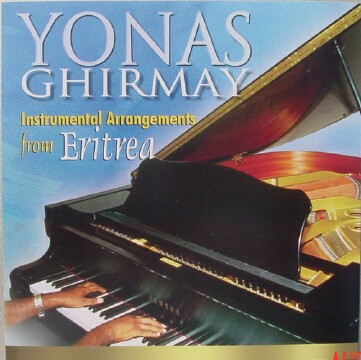
Yonas' CD front cover.

Next, part two

Monday, June 18, 2012

June 20th: Eritrea's Marytrs' Day


                                                   "The price of freedom is eternal vigilance"

Friday, June 15, 2012

A conversation with Andrew Casad


Andrew Casad

Issayas: Briefly, tell us about yourself?

Andrew: My name is Andrew Casad.  I am currently a pastoral liturgist for a Roman Catholic parish in Chapel Hill, North Carolina.  Prior to my present ministry I was studying for and conducting research toward a doctorate in cultural anthropology at the University of California, San Diego.  My studies therein were interested most generally in what indigenous Christianities entailed.  Among many anthropologists there is a laudable though narrow interest constituting the anthropology of Christianity which is concerned primarily with the study of what is often the very recent arrival of Christianity among non-Western or indigenous peoples exploring the transformation of said culture in and by Christianity--usually evangelical and often pentecostal.  I, however, having a long-standing interest in non-Latin Catholic traditions and having focused largely on Eastern Christian traditions in my previous studies in liturgical theology, was interested primarily in exploring apostolic Christianities that were not part-and-parcel of the Western philosophical and cultural milieu which might offer a distinct and comprehensive 'version' of Christianity.  I studied Chaldean/Iraqi/Assyrian Christianity among diaspora communities in both San Diego and Detroit (actually Tory, MI) before turning my focus to the Ge'ez/Ethiopic Rite of Christianity and eventually looked to Eritrea as the place where I could best study both my liturgical and anthropological questions.

 Issayas: This question is more or less political. Even though Eritrea is a different country, in any article or publication relating to Christianity, writing and etc. to Eritrea, I keep reading Ge'ez/Ethiopic Rite of Christianity, etc.  Why do you think it's still put under Ethiopic Rite, (Ge'ez might be appropriate)?

Andrew:  I agree that the term Ge'ez Rite, as used, for example, by Kidane Mehret in Washington, DC, would be the most appropriate title for the liturgical rite used by the Eritrean Orthodox, Eritrean Catholic, Ethiopian Orthodox, and Ethiopian Catholic churches.  It would, of course, be analogous to Latin-, Syriac-, or Coptic- rite that we find in much of the liturgical literature where the designation is based on the language in which said liturgical rite developed and is handed down.  In English, however, Ge'ez is not a generally recognized term while, even for example in Unicode tables, Ethiopic is understood as the term incorporating what is more precisely Ge'ez and all derived languages (Tigrinya, Amharic, etc.).  There is, of course, the sense in which, on the other hand, the name of the Church (ecclesial rather than linguistic distinction) may be, for example, Roman Catholic or Byzantine Orthodox, Antiochene Orthodox, etc., thus indexing not so much the language but the principal see or empire from which the apostolic authority is derived.  In that case I think one could even refer to the Ge'ez Rite as 'Aksumite' however, that seems somewhat contrived as the tradition seems to be concerned more with seeing its the rite as associated with the court of the Ethiopian monarch than with what is no longer home to the empire.  All that said one of the issues, trivial though it may seem, is that while much of the 19th C. literature refers to the Abyssinian ______ (rite, language, etc.) nearly all the 20th C. literature refers to Ethiopian/Ethiopic ______ and therefore all the indexes we turn to are setup that way.  I certainly think it is important to find terms that transcend without ignoring important national differences (such as Habesha for the cultural group, Ge'ez for the liturgy and language) so that both Eritreans and Ethiopians, especially those who in diaspora come together, can share equally in their common patrimony.  Perhaps the 21st is the century for us to speak of Ge'ez ______.

Issayas: In your article in "PRAYTELL" (August 31, 2010), your title was entitled "The Eritrean Catholic Rite: Hybridity and Authenticity", can you briefly describe your argument and can one be hybrid and authentic at the same time?

Andrew: My argument is, in short, that the Eritrean Catholic Church postures itself as both authentically Catholic and simultaneously authentically Eritrean by means of a number of particular liturgical and ecclesial elements.  I think it is only North Americans--even anthropologists--who assume that cultural entities must be "pure bred" in order to be true.  In much of the rest of the world it is mixed/mestizo/habesha/hybrid identity that is not only expected but also recognized as the truest genius by winnowing what is best from each respective "parent" in order to move forward.
                                           A church procession   (photo courtesy of Andrew Casad)

Issayas: In the above article you wrote, "Both Italian and French missionaries did, however, attempt to bring the native Christian population within the fold of the Roman Catholic Church. Their efforts brought about neither the desired widespread unification nor the feared complete expulsion of Western missionaries (as had been the case with the Portuguese Jesuits in Christian Ethiopia two centuries earlier) but rather gave rise to the hybrid Eritrean Catholic Church". Do you think the "hybridization" was a result of a strategy or zeitgeist?

Andrew: I would say that the genius of the new approach is not so much attributable to any plan or even to a European zeitgeist but rather to the Italians' recognition that the Eritrean Christians--though seen as deficient in some ways--were fully Christian and so could be trusted as agents not only of Christianity but also of the Italian nation being declared and defined at that moment.
                                                   A Catholic priest with sistra and prayer stick 
                                                                  (photo courtesy of Andrew Casad)

Issayas: Again in the same article you mentioned that "the Eritrean Catholic Church occasionally celebrates one of several anaphora that, though conserved in the shared Ge'ez Missal, are not used in the Eritrean Orthodox Church. Would you elaborate?

Andrew: I am here relying on Christine Chaillot in her recent work The Ethiopian Orthodox Tewahedo Church Tradition: a brief introduction to its life and spirituality: a brief introduction to its life and spirituality (2002) as well as personal conversations with Habtemichael Kidane (who has a 2008 bibliography as well as his 1998 doctoral dissertation, both published by the Pontifical Oriental Institute) who informed me that the MesHaf Qedus (Holy Book, analogous to the Missal in the Roman/Latin tradition) borrowed in full from the Orthodox Tewahdo tradition into the hybrid Eritrean/Ethiopian/Ge'ez Catholic rite included anaphoras (Eucharistic Prayers) to/through Mary which, though found in the Orthodox 'Missal' were not used and may or have been used in the Eritrean Catholic context.

                                                 
                                                        Enda Mariam church, Asmara (photo courtesy of Andrew Casad)


    Debre Bizen Monastery  (photo courtesy of Andrew Casad)

Issayas: Who was St. Justin de Diacobis and what was his historical significance?

Andrew: Much of this I drew from Jonathan Miran's "Missionaries, Education and the State in the Italian Colony of Eritrea" in the edited volume Christian Missionaries and the State in the Third World (Ohio U, 2002).  St Justin was influential in moving the process of "conversion" of the Ethiopian and Eritrean Christians to (Roman) Catholicism principally because he respected the native Ge'ez clergy and was able to form and ordain local Eritreans (and Ethiopians in and around Adwa) for ministry in the Catholic Church. See also http://cmglobal.org/vincentiana/cgi-bin/library.cgi?e=d-000-00---0vincenti--00-0-0vincenti--0prompt-10---4----ddc-0-0-1l-0-1-en-50---20-about-de+jacobis-4-000321-001-1-0utfZz-8-00--0-0l--11-en-50---20-home---00-3-1-00-0-0-11-1-0utfZz-8-00&cl=search&d=HASHe36bd9638acd4cf42035fb&x=1

Issayas: Who are the Lazarists and the Cappuchini's and their significance in Eritrean history?

The Lazarists, alternatively known as the Congregation of the Mission ( hence , C.M. ) are a religious order (or, more strictly, congregation of priests) devoted to, as the name implies, missionary work in far-flung fields.  Because they are influenced by St Vincent de Paul they are also sometimes known as the Vincentian Fathers.  For a number of political reasons they were expelled from Italy and Germany (and therefore their respective colonies) in the early 1870s.  At this time Eritrea came under greater control of the Italian government rather than, as had been the case previously, other European nations or Italian civilians.  The Italian government (see Michaela Wrong's I Didn't Do It For You, 2005, for a quick overview of this history) then brought in Cappuchins, Italian Franciscan friars/priests (O.F.M., Cap.) to run the missions in Eritrea which marked a significant transition toward the Eurocentrism of subsequent evangelization and education models (see Miran, above, for the latter) under the direction of the Italian colonial state.


      Depiction of Italian Franciscan in Habesha artistic motif  at S. Antonio Church, Godaif, Asmara  
        (photo courtesy of Andrew Casad)

Issayas: In your article  you mentioned that "fearing that the 1894 Bahta Hagos rebellion against Italian rule was instigated by the French, the Italian governor expelled the French Lazarists and invited the Italian Capuchin Franciscans to assume responsibility for the evangelization of the new Italian colony and dominance over its educational apparatus. The Prefettura Apostolica dell'Eritrea was then established (bypassing any mission status) which was to be elevated to a vicariate in 1911. Why was it necssary to bypass the mission status?

Andrew: Effectively, in the political machinations going on at the time, I do not think it would be overstated that this gave the Italian state direct control of the Church in Eritrea making the evangelization efforts there subject neither to the French-dominated Lazarist Congregation of the Mission nor to the Vatican's own Propaganda Fidea (which would have governed everything as a mission territory).  Thus, in this view, Eritrea emerged ECCLESIALLY as formerly under Abyssinian/Ethiopian missionary status to its own Apostolic Prefecture precisely because everything was to be under the direction of the Italian state.  This will, I would contend, play an important role in the concomitant development of an Eritrean identity vis-à-vis Tigrayans, et al.

Issayas: Dr. Edward Sri in his book "A Biblical Walk Through the Mass: Understanding What We Say and Do In The Liturgy" talks about the following: Introductory Rites: The Preparation of the Gifts, The Liturgy of the Word, The Eucharistic Prayer (Thanksgiving, Acclamation,Epiclesis,Institution narrative and consecration,Anamnesis,Offering,Intercessions and Final Doxology) and the Concluding Rites. Are any of the above in the Ge'ez Rite? How is the hybridization and authenticity work in the aforementioned?

Andrew: Dr Sri is really trying to help Roman/Latin Catholics cope with and gain a deeper appreciation of the Biblical/scriptural allusions in our revised English translation of the Roman Missal.  I recently gave a talk on some of this same material which was recorded and may be seen online at http://www.youtube.com/watch?v=6nmXfxDOvlk  Indeed the basic movements of Christian liturgy--word and eucharist--and within the eucharist the thanksgiving, epiclesis, anamnesis, offering, intercessions and doxology--concluded with communion are common to all Eucharistic liturgies.  There are, however, some important differences.  On this I would suggest reading Bob Taft's Beyond East and West (1997) and the new work by Paul Brashaw and Max Johnson, The Eucharistic Liturgies: their evolution and interpretation (Liturgical Press 2012).  There Bradshaw and Johnson outline the Ethiopian Anaphora of the Apostles (one of twenty-two, see pp 157-161) as Preface, Sanctus, post-Sanctus, Institution Narrative, Anamnesis, and Epiclesis.  See also Marcos Daoud The Liturgy of the Ethiopian Church (2005).

Issayas: For the Catholic Church, the "Eucharist Prayer" is the center and high point of the Mass ("General Instruction of the Roman Missal"). Is it similar in Ge'ez rite? If not, how does the hybridization work?

Issayas: Absolutely. The anaphora, Eucharistic Prayer, Qadush, hallowing, consecration, whatever we call it in any language is the center of all Eucharistic/liturgical Christianity.  While the scholastic or analytical method peculiar to Western Christianity was not common among other Christianities they certainly all held the centrality of the eucharist and the real presence of Christ therein effected in the anaphora/Eucharistic prayer.  Eucharistic Prayer is anaphora in Greek or Qadush in Ge'ez.  While the medieval scholastic tradition of Latin/Roman/western Christianity focused in a particular "moment" within the Eucharistic Prayer (Roman Canon) the consecration or "hoc es corpus meam," explaining this with the philosophical description of transubstantiation not necessarily shared by many other authentically apostolic and Eucharistic Christians, a broad generalization that can be made about Eastern Christian liturgical reflection was that the sacredness/holiness of the whole anaphora/Qadush/etc. was more often emphasized than any focus on any particular moment within.

Issayas: what is your plan next? Are you going to publish your ten or so years of research on Eritrean Tewhado and Eritrean Catholic churches?

Andrew:  At present, I am not sure I have enough data to really publish anything comprehensive around a single research question.  I suppose I could turn the original blog post from PrayTell which was itself something of a write-up of a 2010 African Studies conference presentation I gave and render it into a publishable paper.  I must say that one of the most inspiring things I learned from Habtemichael Kidane was that, though he was by his choice no longer part of any formal academic institution that required publications in order to remain in his position and also by his choice no longer part of a religious order that might ask him to do so out of obedience, he continues to do research and publish for the original sake of academia: sharing knowledge with others for the edification of all.

Issayas: Andrew, thank you for taking out time to answer my questions.

Andrew: You're welcome.

FYI,   1)  for detailed analysis of Andrew's reserach:  http://www.praytellblog.com/index.php/2010/08/31/eritrean-catholic-hybridity-and-authenticity/
                                     
          2)   http://ucsdnews.ucsd.edu/thisweek/2005/nov/11_21_internationalday.asp

Wednesday, May 30, 2012

A conversation with Tsegai Medin


(Left) TSEGAI Medin in Buia, Nov. 2010


Issayas: Would you tell us about yourself?

Tsegai: My Name is Tsegai Medin, I am a doctorate student in Quaternary and Prehistory (Paleontology) at the University of Rovira I Virgili, Tarragona (Spain). My studies involve Early to Late Pleistocene paleontological researches (macro-fauna) with special focus at the Danakil Depression of Eritrea (Buia, Mulhuli-Amo…etc) and the Orce sites (Venta Micena, Fuente Nueva-3, and Barranco León) in Southern Spain. More to the point, I am interested in Early Pleistocene sites of Africa, the Levantine Corridor, the Caucasus, and southern Europe, chronologically spanning from ca. 1.8 to 1.0 Million years. I was working as Director of Heritage Management at the National Museum of Eritrea (still I am closely working with the Museum) and I'm still involved on various national and international research projects and conferences. I have international membership in the “East African Association of Paleoanthropology  Paleontology within Eastern Africa” http://www.eaapp.or.ke/AboutUs.html

Issayas: What is Archeology?

Tsegai: Archeology is the scientific study of the past and the way people lived, and interact with their environment based on the things they left behind. The shared ways of life learned by a group of people, including their language, religion, technology, and values are closely studied by Archaeologists by examining artifacts objects made, used, or changed by humans. 

Issayas: What does archeology tell us about Eritrea?

Tsegai:  It is too early to narrate about Eritrean archaeology since the coverage of research on various layers of history is still pending.  However, based on the potentially documented information, from the National Museum of Eritrea, I could summarize the answer of your question as follows; Eritrea is a country of tremendous prehistoric, historic, medieval and recent events, in which the oldest of its evidence is as old as humanity. A number of these archaeological sites have evidences of ancient traces of Human settlements, ancient historic civilizations (which predates the civilizations in our region) and evidences of first introduction of Christian and Islam (in our region) having international significance.  The discovery of such significant archaeological sites in the country can tell then its importance in nation building process as an engine to economic, social and political development in the nation.

Issayas: I have heard some people say what does fragmented pottery found here and there got to do with modern Eritrean history. I guess the comment suggests what does having bread on the table got to do with some pottery from the remote past. What is your response to this kind of comment?

Tsegai: I already mentioned on the second question, that, archaeology is a scientific study of people in the past based on the artifacts they left behind. These artifacts include bones, ceramics, stone tools, iron, shells, charcoal …etc. Like all of these artifacts the importance of fragmented pottery in understanding the life ways of societies in the past is ineffable. Archaeologists spend a lot of time looking to recover the small remnants of material culture left behind by prehistoric societies. Pottery is particularly useful for reconstructing how past groups lived. It is used to determine a person’s social ranking, gender, or even possibly their relationship to others in the group. Archaeologists use pottery and the designs placed upon it to decipher how various areas within the archaeological site were used. For example, one would expect to find pottery in a food preparation or cooking area, but would not expect to find it in a sleeping area. For example, the introduction of pottery was a breakthrough in complex agro-pastoral societies in the highlands of Eritrea. Before the introduction of modern technologies, archaeologists were highly depending on ceramics for typological study and further to relatively date the site under investigation in comparison to other relatively well studied sites. Italian Archaeologist Rodolfo Fattovich was conducting ceramic typological analysis http://www.dankalia.com/archaeology/2709.pdf to understand the development of urban-ism of societies in our region (lowlands and highlands of Eritrea).

Issayas: What are the significant archeological findings to date in Eritrea?

Tsegai: The most significant archaeological sites known to archaeologists in the country are dated from 27 Million years to the present (the recent history of war for liberation). To mention chronologically;

1.The  discovery of new elephant species from Kudo-Felassi which was dated to about 27 Million years; the well recognized Late Early Pleistocene sites of Buia and Mulhuli-Amo (evidences of large mammals among these, the 1 Million year Human evidence having decisive place in filling a gap in the phylogeny of Human evolution); http://www.rivistaitalianadipaleontologia.it/doc/01_abbate_et_alii_RIPS_2004.pdf

2.Evidence of first Human exploitation of marine resources (Abdur Gelàlo and Asfet);  http://personnel.univreunion.fr/ppinet/ECOMAR/papers/2004_Bruggemann_Palaeo3.pdf
https://sites.google.com/a/asfet.net/amanuelbeyin/publications

3.Inventory and documentation of rock art and engraving sites (Hishmele, Adi-Alewti, Quarura, Beati-Mariam…etc);


                                  Fig. 1. Rock art from Der’a, in the southern part of Eritrea

4. Evidences of complex agro-pastoral societies on the highlands and lowlands of Eritrea- E.g. Sites of Greater Asmara Area (Dated to 800-400BC).
http://www.africaworldpressbooks.com/servlet/Detail?no=284

5.The sites of Aqurdet, Bisha and Harenay in the lowlands and Qohaito, Adulis, Metera, Keskese, Toqondaè in the highlands (potential sites that could possibly had a close  mention as part of the mysterious Land of Punt).


                                             Fig.2. The pillars of Qohaito, known as temple-8

6.The 30 years war for liberation (E.g. Naqfa - the triumph of Eritrean perseverance over adversity and oppression and as such is symbolic of a culture of independence, self-reliance, and resistance to oppression that is central to the cultural fabric of Eritrea today).


                                            Fig. 3. One of the many trenches  of Naqfa


Issayas: Where is Buia located and what is the significance of the site?

Tsegai: The fossiliferous area of Buia (100 Km south of Massawa, northern Danakil Depression, Eritrea) was discovered in 1995 during a preliminary geological survey under the aegis of a collaborative research program between the Department of Mines (Eritrean Ministry for Energy and Water Resources, Asmara) and the Department of Earth Sciences of the University of Florence. Further studies were carried out in the area during several field seasons in 1995-1997 and 2003-2004, also involving research teams from the National Museum of Eritrea as well as other Italian and European institutions. These activities led to the discovery of a new important paleoanthropological site at Buia http://www.rivistaitalianadipaleontologia.it/doc/01_abbate_et_alii_RIPS_2004.pdf where an abundant fossil vertebrate collection was recovered, among these was the most complete Human cranium.

                                                                      Fig. 4. Buia Homo Cranium

A large number of archaeological localities with extraordinarily abundant and well preserved Mode 1 (Oldowan) and Mode 2 (Acheulean) tool industries were also identified in this area. The chronology of the site has been established at around 1.0 Ma. The research works on 2011 and 2012 led to the discovery of an important site within the Basin, named after the local name, Mulhuli-Amo. In this locality, evidence of Human parietal bones probably belong to more than three individuals was found. The research will continue at the end of this year and the finding of further evidence is promising.  http://www.shabait.com/articles/nation-building/8016-eritreas-new-specimen-fossils-expected-to-announce-the-progressive-evolution-of-homo-heidelbergenesis-part-ii One of the most important findings from Buia is the 1Million years old Human cranium which is found in association with very rich vertebrate faunal species and highly concentrated Acheulian Hand axes. Therefore, the date of the Human evidence from this site, chronologically fills the big gap between Homo erectus (1.4 Myrs) to Homo heidelbergensis (0.65myrs). The finding of this complete cranium is among the most important discoveries in Human evolution research.


Issayas: What was Adulis and its significance? What are the latest findings in Adulis?

Tsegai: Adulis is well known by classical sources, as the Periplus of the Erythrean Sea (1st c. A.D.) and the Christian Topography (6th c. A.D.) as an important port of trade in the Red sea in Antiquity. The site has been identified for the first time by Henry Salt at the beginning of the 19th century in the Zula Bay. The first field-survey was conducted in 1840 by Vignaud and Petit, as part of the Theophile Lefebvre mission. After 28 years the first excavation has been conducted in 1868 by British soldiers under the direction of Captain William West Goodfellow, under the auspices of the British Museum. At the end of the 19th century the British explorer Theodore Bent produced a graphic documentation of the site. In 1906 Richard Sundström, a team member of the Enno Littmann, excavated a large building in the North Eastern sector of the site. After one year, in 1907 the Italian archaeologist Roberto Paribeni conducted a substantial excavation in different areas of the site. As a result, two Byzantine “Churches” and the early levels of occupation of the site were identified at the South West limit. At the end of the 1960s Francis Anfray, French archaeologist, also conducted an excavation in the central sector of the site focusing on the documentation of a residential area. All these investigations were colonial by nature and failed to follow scientific standard of study, as a result, they produce a biased and distorted publications which totally underestimates the culture and history of this country; precious artefacts were found discarded on the surface; and other important materials recovered from the excavations were transported to their respective museums (Italy, England, France and Ethiopia) awaiting official reclamation process.

In early 2011, a five-year joint Eritreo-Italian project started to conduct the first  scientific excavation, survey, ethnographic assessment, maritime environment studies, geological surveys, and management works, at the ancient port city of Adulis. The result of the stratigraphic excavations revealed masonry structures of an ancient church having an area of 180 sq. meters. Various archaeological artefacts (pots, ceramics, charcoal samples, amphora, stone tools, wall structures, bones, iron materials, coins, beads…etc) were also collected from the stratigraphic excavations and survey. The architecture of the ancient church shows close similarity to the already identified churches in Metera and the Byzantine world. The design of the wall structure of the church enlightens to the locally dominated civilization in the area with trade-connected outside influence. This fact significantly confirms to the locally dominated establishment of the ancient port city of Adulis in particular and the civilizations of the hinterland of Eritrea in general.


                Fig.5. The exposed masonry structure of the ancient temple from Adulis

Even though results of scientific carbon and ceramic seriation dating are pending the results of ceramic typological analysis shows ancient occupational levels that belong to the Adulite civilizations. Based on the findings from the stratigraphic excavations, the lower occupational level predates the Axumite civilization. The discovery of the Adulite civilizations will surely concern the previously known civilizations in the region and this is an incredible result in the ancient history of East Africa. More importantly, the results of this seasons excavation, survey and laboratory analyses are very important in preparing an alternative history of Eritrea and  also in out-dating the biased history of  the country published during the colonial times.

The ancient port city of Adulis along the coastal fringes of the Red Sea is the site of global importance and holds a phenomenal amount of information about the trade systems (with the Romans, Arabs, Persians, Indians and Chinese) of this part of the ancient world between 500 B.C. and 700 A.D. It has also an important insight into the economy of the littoral and highlands of Eritrea.  Modern Adulis appears at first glance to be little more than a series of mounds, with hardly a stone standing. It must have been deliberately destroyed, never to rise again. Perhaps this happened in the well documented Arab raids of AD 640.

Issayas: Today's Adulis is 7 km. inland than the Adulis mentioned in the Periplus of the Erythrean Sea (a 1st century AD. sailors/trader manual) which was 3 km. inland. What happened? Even with the 3 km. mentioned in the above mentioned book, how was Adulis considered a maritime power when it was located inland?

Tsegai: The ancient port city of Adulis is located at the Red Sea coast alongside the western shoreline of the Gulf of Zula. It is situated on an area of coastal low-lying land that has been drained by major rivers. According to the mid 1st Century AD writing of Periplus of Erythreaean Sea, Adulis was a port city situated at 3.3km from the sea. It declined at the mid 7th Century (Peacock, et al., 2007). Since its fall, enormous environmental change took place at the site and nearby coastal area. At present, the distance to the sea has been widened to about 7km and a significant amount of alluvial sediments has been deposited at the site, which resulted to the retreat of the sea backwards. Geologically, the ruins and all adjacent coastal area are covered by substantial fluvial derived alluvium overburden. It comprises un-consolidated alluvial sediments transported from the central highland hills and Mount Ghedem.

Issayas: Are there any other places where there are major archeological findings in Eritrea beside the eastern side?

Tsegai:  Yes, there are many. The National Museum of Eritrea has an extensive plan to conduct a national inventory (to make a survey and ethnographic inquiry in order to understand the distribution of the archaeological sites within the country. However, throughout the country you find traces of archaeological site. 

Issayas:  Tsegai, thank you for taking out time from your busy schedule to talk to me. Good luck with your studies.

Tsegai:  You’re welcome.

Saturday, May 12, 2012

A conversation with Robel Afeworki

Part Two


Robel Afeworki (left) and Simret Haile (Bucchi)

Issayas: Why did you want to combine "geez music" and "trance music"?

Robel: If the ground failed to move for you, it may not be your fault. Music is evolving in new dimension with remarkable dynamics and pace of novelty. If it weren’t for entertainment, the global music industry would collapse, cultural literature would vanish and no-one would reap its social benefits. For as long as Homo Sapiens have trod the earth, the power of emotion has made human brain to experience excitement and relaxation in comparably more than the mundane survival habits of other primates. Nature selected us to experience the gratitude of music where pleasure incentives are entangled through evolutionary pavements of change, but, the question is that do we really want to be part of the change? Does it matter to follow the path of musical rhythm? Are they over- rated all too brief flashes of fabulous moments or do they signify an elevated level of cultural messages conveyed through out the course? It is true in practice the journey is more important than the destination. As Confucius once said “Study the past, if you would divine the future.” The fundamental conception of Eritronic is arisen from key theoretical framework which embraces the culture and originality of Eritrean context. We need change and variety in Eritrean music. Although, the cultural “Guya-la” is our cultural heritage, undeniable fact, still we are missing the flavor of creativity and similar pattern of musical styles have been evident in contemporary Eritrean music; repetition of alike beats confined with only musical instruments like saxophone, drum machine and “ Deg -dime” kibro beats everywhere. These are my personal empirical observations through out my experience which I have decided to experiment new stuff. Remember, I am not degrading the Eritrean contemporary artistic works but we need to catch the spirit of change for the betterment of our culture and society.

In music, you are either in or you are out. If you are in, you need an ear for every beat, rhythm and tunes through out the globe to create the wholesome panoramic musical concept of understanding. The pragmatic idea of combining "geez music" and "trance music" came to me on one Friday night when I was chilling with friend , Simret Haile (Bucchi), in a relaxed mood in a pub. There was a boring local song and, suddenly, David Guetta’s “sexy chick” was hitting the surround stereo. We shared the musical experience of progressive, trance music, and its global domination. After, Simret persuaded me that we needed to revolutionize Eritrean music. I started with trance beats and he followed with it with geez ziema. The next morning it took us away from energetic excitement of listening and ended up in professional music studio.We galvanized the whole team in Gerry studio and embarked with Eritronic project. The rest, as they say,  is history! It was meant to happen. I had my heart set on a career in radio host from an early age though I have never imagined it would include music producing in a real studio. These past years have metamorphosed from wild child ambitions to sophisticated leading person who is making great strides with my radio career, music and confidence. The experience I have acquired in this project is awesome. Eritronic is zero (non) profit, non-commercial product dedicated for young Eritrean people to serve as a slingshot for change and platform of improvements. It is a peanut advancement made in music industry just like an iceberg; where you have seen only 1/ 5 of our achievements. I promise you  lots are coming in subsequent years from our team and expect more from every Eritrean interested in music and culture.

Issayas:  Are there similar traditional music in Eritrea that resemble trance or geez music?

Robel: I think trance music is the first experience in Eritrea, we are far away from progressive music. Well , almost all Tigrigna songs of Eritrean music build on the bases of geez ziema excluding some  ethinic Eritrean cultural music which has their own traces of geneaology of music to classical Zema.The most important thing should be reminded here is geez ziema yet haven’t be expressed with notes, scales and chords of musical sciences.

To check for a sampler of Eritonic music:

https://www.opendrive.com/files/Ml8xNTY1NTA3XzFhZHRj/Eritronic%20Sampler%202011.mp3

Issayas: Robel, thank you for your time and insight.

Robel: Thank you.