Sunday, July 29, 2007

KIDANE KIFLU & THE JACK KRAMER PAPERS

THE JACK KRAMER PAPERS: HISTORICAL PERSPECTIVE


PART THREE

Issayas: Would you tell readers about yourself?

Mr. Kramer: I’ve worked as a reporter for the Wall Street Journal (two years), as Business Week Magazine’s Cairo-based Middle East Bureau Chief (three years) and as a Staff Editor at Time Magazine (three years.) I’ve also worked as a freelance producer for the Public Broadcasting Service, During the Civil Rights Movement in the mid-sixties; I was Birmingham Alabama bureau chief for the Southern Courier, a movement newspaper associated with the Alabama Christian Movement for Human Rights and the Southern Christian Leadership Conference. In addition to the above outfits, I’ve written for the Nation, the New Republic, the New York Review of Books and New Society, and a British periodical.

As a reporter I’ve covered banking and oil, most particularly the oil crisis, which took me from Texas to Saudi Arabia, Algeria, Geneva, London, Vienna, and Rome. I was accredited three times as a reporter in Vietnam (1967, 1968, and 1969), and covered major battles at Cam Lo, Con Thien, Gio Linh and Khe Sanh. I covered the Six Days War in Israel, the war in Eritrea, the war in the Western Sahara, the revolution in Iran (from Teheran, Ahwaz and Abadan), the civil war in Lebanon (I was there when the French and US barracks were bombed and helped restart Beirut’s English-language Daily Star, and in 1994 I covered both the French Foreign Legion and the US Marine Corps during the Somali troubles. In addition to the high spots, I’ve traveled extensively through East Africa, including, of course, Rwanda, about which I’m now co-writing a book, King Solomon’s Crimes. I’ve also written a book about the ‘sixties, Travels with the Celestial Dog, which was published by a London subsidiary of Random House, Wildwood House, and which contains extensive material on Vietnam and Eritrea. I’m a veteran of the Marine Corps, and a graduate of Stanford and Columbia University’s Graduate School of Journalism.


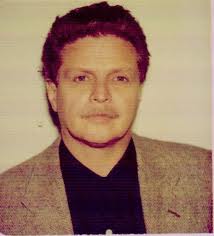
  Mr. Jack Kramer


Issayas: You were one of the first Western journalists who reported on Eritrea. How did you get interested in Eritrea at that time (1968)?

Mr. Kramer: I wish I could say it was my perspicacity that got me interested in Eritrea. In fact I was quite young and like most Americans, I barely knew Eritrea existed. My only reporting jobs had been for the civil rights paper, the Southern Courier, and for a provincial newspaper in Britain. The previous summer I’d made a friendly bet with a student reading law at Cambridge, Malcolm Ashton, that come the summer of ’68 I’d make it to Addis overland before he did. I got my Egyptian and Sudanese visas; in London, the Ethiopians told me that I didn’t need one. I traveled by third class railway coach to Port Sudan, where I tried to book passage on a Greek freighter and the Greeks told me all about Eritrea, and how you really couldn’t go there because of the war. So I got back on the train to Kassala, where I slept on the floor of the police post, and was told all about a fellow who shared the same room with us (only about half of us were inmates). He had a huge head, and they said he was in jail “for throwing bombs at the Eritreans” i.e., Eritrean activists living in Kassala. Of course I was interested, but still more interested in getting to Addis overland, and was having no luck with the Ethiopian consul in Kassala, who kept putting me off. Eventually I ran into the Indian fellow who ran a radio shop. Eventually he put me in touch with a Sudanese fellow called Hassan mi Jack who had a small shop from which he rented and repaired everything from bicycles to refrigerators. I remember he had a couple small posters on the wall, one of Mao as a young scholar in Kiang Si, and another of a female Chinese guerrilla about to pitch a grenade. For a small businessman, he was quite a character. I remember he said, “My name is Hassan mi Jack. They call me Jack Palance. The Man without a Gun. Only I have a gun.” And with that he pulled out a .38 revolver. We talked for some time, and he suggested that come sundown, I get a table at Kassala’s Central Gardens, order tea and wait. I did.

Issayas: Can you tell me more about the guy who was in jail “for throwing bombs at Eritrean activists”? Who was he? Who was he working for,etc.?

Mr. Kramer: No. I had the impression he was mentally disturbed, and in any case, just hireling. Regardless, at that moment I was not working as a reporter.

Issayas: You met Kidane Kiflu in Kassala and then he convinced you to go to Eritrea. Would you describe Kidane Kiflu?

Mr. Kramer: I didn’t have to wait long for Kidane to show up with some friends. We talked a while. He asked if I had any of my articles with me. I showed them to him. It was hard not to be impressed by his earnest and straightforward manner. He was altogether unaffected, wearing a white shirt that was clean and pressed, and black trousers. I don’t think that at that point he offered to take me into Eritrea. I was impressed, and you can tell from my C.V. that I’ve covered some trouble spots, but I don’t go looking randomly for trouble and jump at the chance to cover it whenever it comes up. At that point, I would have been happier getting a visa and a bus to Addis. We met again, and eventually he asked me if I’d like to go over the border into occupied Eritrea with ELF guerrillas, meet some locals and come back to Kassala. I said thanks but no thanks. But then the Ethiopians gave me a firm and final No, and so I asked him if the ELF could take me all the way across Eritrea to Asmara. He didn’t say yes right away. It took awhile; I went to see him where he worked as a tailor, and met some other activists. Eventually I got the go-ahead and six of us left Kassala in an old Peugeot taxi that almost immediately left the road and took off straight out over the desert. The five were myself, two cadres (Abdullah Hassan and Aberra Mekonnen) and three guerrilla scouts, Ismail, Ibrahim and Ali. As I remember, it took almost three days just to reach the border. It was hard just to get a camel.

Issayas: How long where you in Eritrea? And would you describe your stay with the fighters?

Mr. Kramer: My account at Hoover should say how long I was in Eritrea. As I remember it was just over a month, more than three weeks of which were spent with the ELF.

Issayas: In the “Kramer Collection” at the Hoover Institution Archives there is a transcript of the audio tapes you made in Eritrea in 1968. In it you mentioned that you met the guerrillas (fighters) through an Indian contact in Kassala. What does contact mean? Who was this Indian and what was his connection with the ELF, if any?

Mr. Kramer: I can’t remember any more than what I’ve written above. As I remember, I just ran into the fellow. It wasn’t unusual. Reporters are curious. And in a backwater like Kassala in 1968, everybody is interested in an outsider. It was easy to talk to people; sometimes too easy.

Issayas: I am going to start backwards and ask you, where and when did you learn about the murder of Kidane Kiflu? And what was your reaction?

Mr. Kramer: I learned of Kidane’s death years later reading propaganda that the EPLF sent me. I’m usually pretty cynical reading any sort of propaganda, but reading about Kidane’s death and how he died ambushed me. It was partly because of how he impressed me, and that he’d trusted me, but I wasn’t in Kassala that long and he didn’t come with us. So I think one reason it hit me so hard was that he represented what I saw in Eritrea. There are six ghosts who follow me wherever I go. My father, Kidane, my old drill instructor at Parris Island (his name was Jettie Rivers and he won a posthumous Silver Star while I was in Vietnam) and three old geezers who kept me writing (an American, Malcolm Cowley, and two Brits, James Cameron and Oliver Caldecott).

Issayas: You mentioned that one of the ghosts that follow you around wherever you go is Kidane’s. My long search to locate you partly was that my suspicion had always been that you were turned off (after the brutal murder of Kidane) from reporting about Eritrea. Was my suspicion well founded?

Mr. Kramer: I didn’t make myself clear. I was briefly turned off by reading about in-fighting. I thought to myself, that’s all these guys need, with all their troubles. Fighting among themselves. Of course I read the propaganda, but it didn’t convince me. Soon enough, though, I began to understand, and was once again interested in Eritrea. If anything turned me off writing about Eritrea, it was the great wall of indifference I met when I tried to convince quality publications that Eritrea was worth writing about. I told them basically that we were fighting a guerrilla war in Vietnam, that Vietnam was heavily covered, and meantime, we had hardly any coverage from independent (i.e., non-ideological) reporters of what it was like on the other side of a guerrilla war, the Liberation Front side. They were more interested in my Vietnam reporting. In fact, it was easier to convince them to hire me to write and report for them on staff than it was to get them to accept one freelance article about an African country. Aidan Hartley, who has just published a book called The Zanzibar Chest about Rwanda, sums up what it’s like. He recalls hearing from his Reuters boss in the middle of the Rwanda genocide, which was still barely reported (the horror wasn’t widely known until after the war). “Sorry, mate,” his boss said. “We’re not going to be able to use any more Rwanda material from you.” Hartley asked why not. The answer: “It’s not making any money for us.” In other words, papers that subscribed to Reuters weren’t buying anything. Another example, which has shades of the current scandal dogging the NY Times,: After I left the guerrillas and got to Asmara, I ran into Times reporter Eric Pace, who took my photos of the guerrillas, took my story, said it should be in the Times, and promised to send it in. He sure did.

When Eritrea’s Liberation Front let a Marine Corps veteran, credentialed as a reporter in Vietnam, accompany them, they were in effect handing a fat goat to whatever news outfit got the material. What the reading public got was tripe you’d never call fit-fit. What appeared in the paper (under the byline of their reporter) was a thoroughly gutted version of what I provided, without a hint that an ideologically independent US reporter had been with the guerrillas. (Years later, this same Times reporter published a political novel about Iran that appeared either just before or after the revolution; in it, the word “ayatollah” never once appears.) This is a lot worse for Eritrea and for Africa than it is for the small clutch of reporters like me. We take chances, including professional ones; we expect to take our lumps. For Africa, it means grotesque reporting. Aidan Hartley notes how much news (Liberia, for example) comes out of Africa during August. Why? August, he points out, is “the silly season”, when “real people” are on vacation and editors are hard up for what they consider news, so they run stuff from Africa that they’ve been ignoring all year. I’d add another reason: When an outfit sends a reporter to Africa, it likes to show off. That’s why you’ll see big stories running about Africa long after the news to which the story is pegged. That’s because the news really isn’t pegged to the news, which was ignored when it happened. It’s pegged to their reporter’s tour. Reporters for big American outfits like to laugh at the way African news programs always start out with the president’s schedule, even if he’s just meeting with the Ministry of Female Sport, while elsewhere in the world, the Berlin Wall is falling.

The way rich, sophisticated US news operations report Africa, with “news” neatly corresponding with the month of August or their reporters’ tours, is just as absurd. Hartley praises local African reporters in Rwanda (and I can confirm that many, all Bahutu, did great work exposing the genocédaires persecuting Batutsi), then laments how their work was often either ignored or stolen by outfits who were paying big bucks to have their own reporters on station. He calls it “the big foot from the big hacks.” Halhal is an example. Years after I left Eritrea, western reporters began to travel somewhat regularly with the guerrillas, thanks to EPLF work, the availability of vehicles to carry reporters, and greater security. During this period, I ran into Times reporter John Darnton in Nairobi who had my wife and I over for supper. John, who is a good reporter, had recently spent almost as much time with the guerrillas as I had. Though it was now a much more common story, and the Eritreans were much less “the other side” (the Stalinist Mengistu having taken over Addis), the Times ran his story in three parts, with each part starting on the front page. Needless to say, there was no Halhal to which to peg all this. Which makes the Nation, and several British periodicals that published my reports out of Eritrea, look pretty good. It was also a British outfit (started by two successful editors at Penguin, Ollie Caldecott and Dieter Pevsner) who published my book on the sixties, Travels with the Celestial Dog, which includes a long chapter on Eritrea. Likewise, Hoover showed prescience. Given their conservative reputation, I was cautious, but a) I wasn’t disclosing anything the Eritreans had not disclosed openly to me, b) Peter Duignan assured me my account would be unedited and open to anyone and c) I was guided above all by Kidane’s obvious concern just to get the story out, available not just to reporters but to researchers and writers. Hoover lived up to its commitment not to edit me, and to make the collection available in the open stacks. In general, it showed more foresight than news outfits in recognizing the substance of the Eritrean movement, Marxist or not. (Though I must say I was somewhat baffled by their lack of interest in Rwanda, which seems to me of equal interest.) By the way, I’ve been getting complaints from one of the ghosts who hike around the world with me. When I mentioned them to you, I neglected to mention Ollie Caldecott. He was, is (even in death), inspirational.

Issayas: You also mentioned that you learned about Kidane’s death from reading EPLF’s material that they sent you. How did they contact you especially since there was no EPLF at that time?

Mr. Kramer: After the ELF/EPLF split, virtually all the correspondence I got was EPLF; in short, they continued the correspondence that Kidane began.

Issayas: The ideas that Kidane expressed in his letters to you, did he ever express to you verbally the same ideas before in Kassala?

Mr. Kramer: It is too easy for me to read those ideas into what Kidane talked about in Kassala. Maybe they were there, but he was more guarded.


Picture courtesy of Mr. Jack Kramer. (Kassala, Sudan.1968)
Kidane Kiflu (second from the left back row), Aberra Mekonnen
(second from the right front row). Jack Kramer (second from the left sitting).

Issayas: Were you suspicious from reading his letters to you that he was a threat to the status-quo of the ELF or was he in danger at that time?

Mr. Kramer: I was not suspicious that he was a threat when I read his letters to me, but I was nonetheless naïve. I was still young. I admired the movement. I was not critical enough. So when I got his letters, I thought to myself, “Don’t you guys have it hard enough without fighting with each other.” My basic reaction was disappointment. Which I must admit is a silly reaction for a reporter, but that’s how it was.

Next, Part Four. Kidane’s childhood, education and nationalism. Interview with Minister Naizghi Kiflu (no relation) and Professor Berhe Habte-giorgis.

KIDANE KIFLU & THE JACK KRAMER PAPERS

THE JACK KRAMER PAPERS: HISTORICAL PERSPECTIVE


PART TWO

BACKGROUND

In order to understand the significance of the “Jack Kramer Papers”, it is important, at least briefly, to get a short historical background of 1960’s Eritrea.

By 1965, the ELF had divided Eritrea into five military zones/divisions to fight against Ethiopian forces (Actually, they first formed four zones and later added a fifth zone). The divisions were modeled after the Algerian FLN (Front Liberation Nationale).

The commanders of the five divisions were as follows:

• Mohamud Dinai, 1st zone
• Omar Ezaz, 2nd zone
• Abdulkarim Ahmed, 3rd zone
• Mohammed Ali Omaro, 4th zone
• Woldai Kahsai, 5th zone.

It is also important to understand the organizational structure of the ELF at that time. At the top was the Supreme Council (SC) based in Cairo.

Some members of the SC were:

1. Osman Saleh Sabbe
2. Idris Osman Galawdios
3. Idris Mohammed Adem
4. Taha Mohammed Nur, etc.

The next tier was the Revolutionary Command (RC) based in Kassala, Sudan. The main task of the RC was to coordinate the five military zones in Eritrea.

Some members of the RC were:

01. Muhammed Saed Adem
02. Muhammed Ismail Abdu
03. Azzein Yassin
04. Omar Haj Idris
05. Abdu Osman
06. Jaffar Muhammed
07. Ahmed Muhammed Ali
08. Mohamud Muhammed Saleh
09. Ahmed Ismail
10. Saleh Hedug
11. Woldai Gedey
12. Abdulkadir Osman

There were also five political commissioners or commissars who were attached to each zone.

They were:

• Ahmed Adem, 1st zone,
• Mohammed Shikini, 2nd zone,
• Ahmed Mohammed Ibrahim, 3rd zone,
• Romadan Mohammed Nur, 4th zone, and
• Isaias Afwerki, 5th zone. (For more on this, read SEWRA ERITREA: The Ups and Downs of the Eritrean Revolution, by Alamin Mohammed Said)

The zonal structure in the field had its complement in the Supreme Council, whose leading figures vied for control of one or another of the zones, completely bypassing the intermediary structure of the Revolutionary Command. In 1967 Ethiopia conducted a major "counterinsurgency campaign". The military campaign was conducted with the assistance of the United States and the Israelis and its main were:

1. The creation of strategic hamlets (create villages around Ethiopian military garrisons) in an effort to "dry the sea to get the fish" or to "cut the lifeline of the mass support" for the fighters. Barka, Senhit, Semhar and Sahel became the primary targets of this scorched earth policy. Many villages were burnt down and there was a mass exodus to the Sudan of some 30 – 40,000 Eritreans.

2. To attack the divisions one at a time, fully understanding the absence of coordination among the zones.

The zonal structure of the front proved incapable of responding effectively to the Ethiopian offensive, and soon after led to a political crisis in the ELF.
A reform movement (the Eslah) emerged with the intention of creating a unified army and command structure. In June 1968 military commanders and political commissars of the 3rd, 4th and the 5th zones met in Aradeib. The following month, the aforementioned people along with the representatives of the fighters, again met in Aradeib. They agreed to get rid of the zonal divisions, to unify the army under a single command, to organize the masses in associations, etc. During the meeting, the first and the second divisions were absent.

This was the overall situation in the second half of 1968 in Eritrea when Jack Kramer, a young American journalist arrived.

Next, Part Three. Interview with Mr. Jack Kramer.

KIDANE KIFLU & THE JACK KRAMER PAPERS

THE JACK KRAMER PAPERS: HISTORICAL PERSPECTIVE


I posted the following series on various Eritrean websites a while back. Some people have asked me to re-post this important story again. Agreeing with their request, I am re-posting the entire series in eight parts.

Issayas Tesfamariam


PART ONE
INTRODUCTION

When I got home on September 5, 2003 from work, my wife noticed that I was unusually excited. It was not our wedding anniversary, she figured. But she wondered what the excitement was all about. I was not going to tell her until I was sure myself. What almost got me do the jitterbug was the thought of the finality of a search. I picked up the phone and dialed a number. I did not know who was going to be on the receiving end, but I was hoping that it was the person or the number of the person I had been looking for since 1991.

Back in 1991, I read the contents of a collection called ”Jack Kramer Papers 1968-1969” at the Hoover Institution Archives, Stanford University in Palo Alto, California. A young American journalist named Jack Kramer donated the collection. The collection includes various ELF (Eritrean Liberation Front) pamphlets, letters, pictures and audio reels. Beside the pictures and the audio reels (interview), what got my antennae raised were the letters.

The letters include the following:

• 3 letters from Kidane Kiflu to Jack Kramer (1pg, 8pgs, 4pgs dated Oct.29, 1968, Nov. 27, 1968 and April 3, 1969, respectively).

• 1 letter from Mohamud Dinai to Jack Kramer (2pgs, dated 12/9/’68).

• 1 letter from Kramer to Kidane (1pg, dated Feb.6th 1969).

• 2 letters from Osman Saleh Sabbe to Kramer (1pg each, dated 5/11/’68 and 27th Dec.’68, respectively).

• 1 letter from Fathay Mohammed Ahmed Saleh to Kramer (1pg, dated 1/4/’69).

• 1 letter from Kramer to Osman Saleh Sabbe (2pgs, dated Feb.7, 1969).

• 1 letter from Kramer to Woldeab Woldemariam (1pg, dated Feb.24, 1969).

What is most interesting, at least to me, is the contents and the uniqueness of the letters of Kidane Kiflu to Kramer. Who was Kidane Kiflu? What are the contents of the letters? etc. are questions that this article/interview will attempt to answer.

The format will be difficult to categorize, since I am experimenting with it myself. Suffice it to say that it is an article/interview format. First, I will give a short background of the historical period (late 1960’s) to which the collection belongs because of the importance of the historical period in the Eritrean struggle. Second, I will interject interviews with six people (Mr. Jack Kramer, Dr. Tom Killion, Professor Berhe Habte-giorgis, Brig. General Ghirmay Mehari, Minister Naizghi Kiflu, and Minister Woldenkiel Gebremariam) at various junctures that will be pertinent to the topic discussed. I conducted the interviews via phone and e-mail from California to the East Coast of the United States and Asmara, Eritrea at different times.

Before I start with this article/interview, I would like to take you back to September 2003. Around the beginning of September 2003, I was thinking as to what important Eritrea related historical events would be up coming. Of course, September 1, 2003 was the 42nd anniversary of Bahti Meskerem. The first shot that announced the birth of the Eritrean armed struggle for independence from Ethiopia. I also remembered that September 8-10, 1968 was the period where the “Battle of Halhal” took place. Well, that was 35 years ago! I knew from the “Jack Kramer Papers”, that Mr. Kramer was near Halhal at the time of the “Battle”. What I wanted to do was introduce the “Jack Kramer Papers” on the 35th anniversary of the “Battle of Halhal”. But I had one problem since I first read the “Kramer Papers”. The problem was that I had too many questions, at least in regards to the collection, but I could not locate the person who was in the position to answer them. Furthermore, I could not find any articles written by Jack Kramer about Eritrea from 1969/70 on. Before that, Jack Kramer was one of the few Western journalists who wrote about Eritrea and visited Eritrea (1968) with the ELF.

  
                                                                  Mr. Jack Kramer

To get answers for the questions that I had, I started searching for Mr. Kramer. All the available leads led me to nowhere. Since the collection was obtained through Dr. Peter Duignan (a senior fellow at the Hoover Institution), I asked Dr. Duignan as to the whereabouts of Mr. Kramer, sometime before 2000. In April 2003, I asked Dr. Duginan again. To my surprise, he mentioned that Mr. Kramer had contacted him through an e-mail back in 2001. Armed with this new information, I went back to the Hoover Institution Archives and with the help of Ms. Linda Bernard, Deputy Archivist, we followed a paper trail. Sure enough, we found the e-mail message that Dr. Duignan mentioned. In it there was a phone number and of course, the e-mail address. The question then was, "were both the e-mail and the phone number current?" After I called the number and introduced myself, I was waiting for Mr. Kramer to come to the phone. The voice on the other end sounded the same as the one on the tapes that I heard 12 years earlier. That was when I did the jitterbug. Not quite, but close. It was a long time coming! This article/ interview will be in parts. With the permission that I received from Mr. Kramer and the Hoover Institution Archives, I will present some pictures, two/three letters, a sketched map to go with this article.I will also present pictures I received from Professor Berhe Habte-giorgis and Brigadier General Ghirmay Mehari.

Before I finish this introduction, I would like to thank the following people for all their help. Mr. Jack Kramer, Dr. Peter Duignan, Linda Bernard, Heather Wagner (Audio/Visual Archival Specialist), Karen Fung (Africa Curator, Green Library, Stanford University) and from the Hoover Institution Archives Carol Leadenham (Reference Assistant Archivist). Last but not least, my thanks to the interviewees for their time and the interview.

Next: Part two. A short historical background of the late 1960's Eritrea.

Saturday, July 28, 2007

PRESERVING ERITREA'S RECORDS… the legacy continues


The Research and Documentation Center. Asmara, Eritrea.

I just returned from a conference on micrographics which was held in Cheyenne, Wyoming. The conference was the 20th Midwest Micrographics Conference hosted by the state of Wyoming. Representatives of various States (Nebraska, South Dakota, Wisconsin, Illinois, etc.) presented their states’ respective state of preservation, accession, and etc. Throughout the presentation, I became more and more appreciative of the work that RDC (Research and Documentation Center of Eritrea: the de facto National Archives and Library of the State of Eritrea) has been doing with limited resources and manpower since 1991. RDC was established in 1991.The collection and preservation, however, was a legacy that started during Eritrea's War of Independence from Ethiopia (1961-1991) inside the liberated zones and in the Diaspora, whose legacy still continues today.

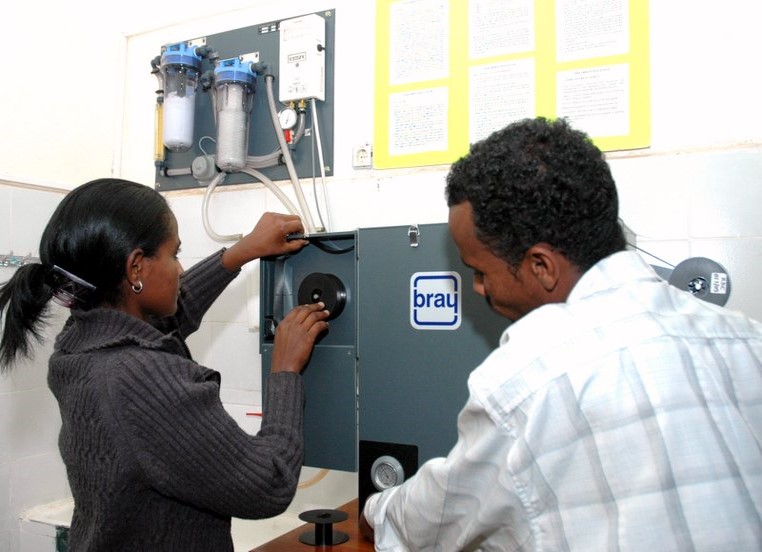
I have been involved in one way or another with RDC since 1993, when I went to help set up the microfilming department. Since then, the Center has moved in leaps and bounds. As a matter of fact, understanding the priority of preserving Eritrea’s documents, the Eritrean government , a couple of years ago, spent half million USD (US Dollars) to buy the latest equipment (scanners, readers, microfilm camera, etc.) for the aforementioned department. Similarly, the government spent almost a million USD about 7 or 8 years ago and bought audio-visual equipment to digitize the entire audio-visual collection.


The Microfliming Department with some of their latest equipment


RDC’s main objectives are as follows
  • To identify and collect relevant documents.
  • To preserve collected Eritrean historical records of written materials, audio and video records, newspapers, cartographic and photographic materials, religious parchments, artifacts and etc. The preservation is done through digitization, microfilming, binding, storing through environmentally controlled conditions, etc.
  • To create awareness of documentation within the society.
  • To give training on records and archives management.
  • To organize and allow public access to the documents.
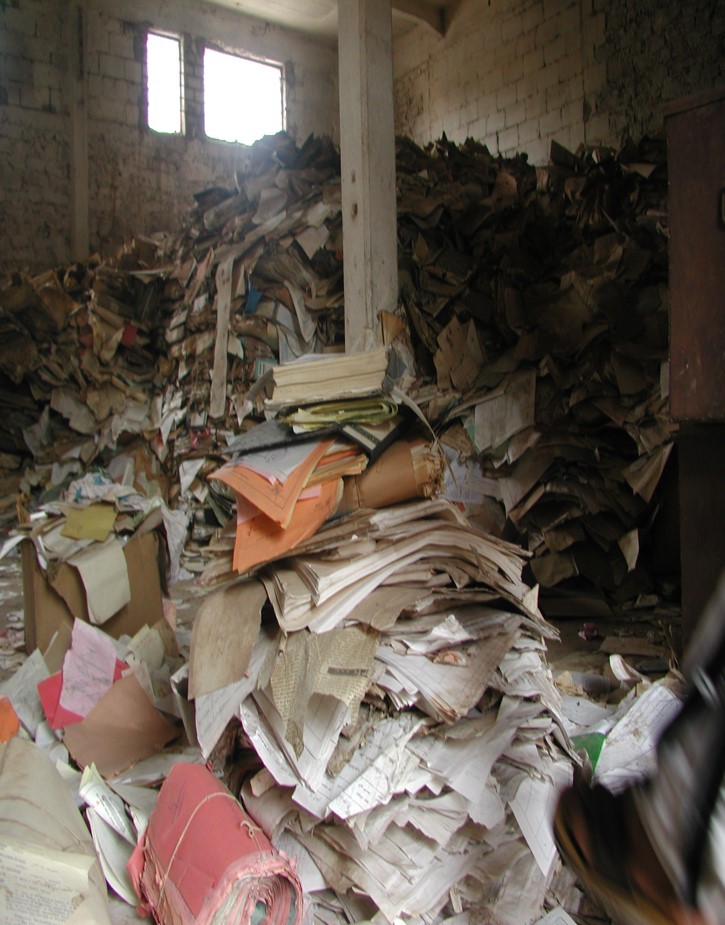
An example of the state of documents found after
Eritrea's independence from Ethiopia. 


The following two pictures: Students
participating in the process of retrieving documents
during their summer (ma'tot) work program.


Below: Students loading the records to be trucked
to RDC's processing center.


Below: Visual presentation of the arduous process of acquisition, processing, preservation and access.
Also below are example-sample of some of the documents and IT Service.


Below: The Audio Visual Department.


RDC's holdings are very impressive. Here are some examples of the archival collections.
  • The Italian Period (1890-1941): Civil Tribunal Office, Private Notary Office, Decrees from 1901-1938), etc.
  • The British Period (1941-1952): British Military Administration Records.
  • The Federal (Eritrea-Ethiopia) Period (1952-1962). Biographies of members of Parliament. Minutes of the meetings of the Parliament , etc.
  • The Ethiopian Period (1962- 1991): Intelligence Records, Military records, etc.
  • The Armed Struggle Period (1961 - 1991): Eritrean Liberation Front records, Eritrean People's Liberation Front's records, Records of EPLF's departments, Dimtsi Hafash’s (Voice of the Masses’) radio broadcasting records.
  • Records of Post Independence (1991 - present): Records of the Referendum Commission and the Constitution Commission.


Collection of part of the Derg's (Ethiopian military junta )
military operations


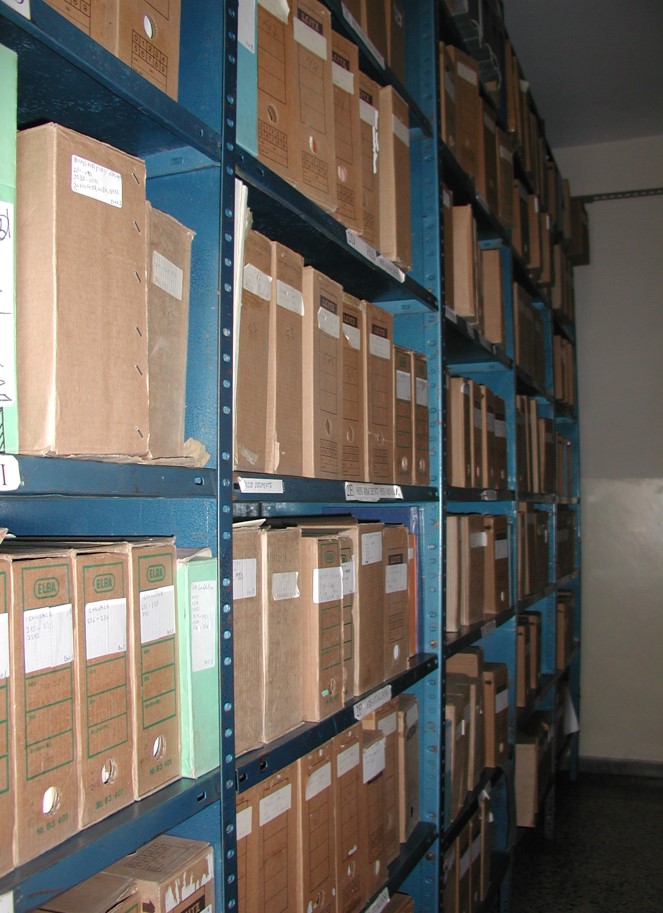
 Above: documents preserved in archival acid free boxes.


Above: religious parchments and artifacts.


Above: Photographic Restoration Unit.


Above: an example of a damaged photograph.


Above: restored photograph of the damaged picture above.

Beside government records, individuals are encouraged to donate their collection to RDC. The number of individual collections within RDC is increasing. I would like to give two examples (one on the national level and another on the international level) of the recent addition to the growing rich depository of Eritrean history.
The first example is the Beyin Ukbaledet Collection. This collection is acquired from Mr. Beyin Ukbaledet who is a resident of Himberti. Mr. Beyin Ukaledet was the secretary of Fitwerari (title) Ghebremariam Tesfamariam who was the administrator of Kebesachiwa and Logochiwa from 1950 to 1963 (Geez Calendar or 1958-1971 Gregorian calendar). The collection is 92 box files and deals with the following administrative issues of the region.
  • Petitions
  • Complaints
  • Weekly and monthly reports
  • Cooperative loan lists
  • Demographic reports
  • Medical reports
  • Lists of families and villages under the administration
  • List of the Federal Parliament members(Eritrean-Ethiopian Federation: 1952-1962)
  • Documents related to relief and support of deprived families.
The second example is the Richard Greenfield Collection. Once the cataloging of this collection is completed, it is expected to be an extensive private Africana Collection, which in of itself can be quite sufficient to establish a major African Studies Research Center. Richard Greenfield is the renowned British historian of Africa with 45 years of teaching of African history in the continent. Among the places that Professor Greenfield taught are: Ethiopia, Tanzania, Zimbabwe, Kenya, Ghana, Sudan, Nigeria and Somalia.


Professor Richard Greenfield in Asmara, Eritrea.


Above: part of Prof. Greenfield's Collection
The Richard Greenfield collection includes:
  • Several thousands of historical photographs on various subjects
  • Color slides on various subjects
  • Extensive notes on various subjects
  • Ghanaian traditional history
  • 80 videos on African history
  • Records on Pan-Africanism with rare volumes
  • Rare documentations produced by African nationalists in the early years of struggle against the colonial systems.
  • Extensive record on Eritrea
  • Extensive record on Ethiopia
  • Extensive record on Somalia
  • Records on Nigeria and etc.
When asked why he had given his collection of 45 years of teaching materials to Eritrea, Professor Greenfield replied by stating that he donated to the people and government of Eritrea in honor and tribute of their resilience and resolve in achieving independence after 30 years of struggle. Professor Greenfield currently resides in Asmara, Eritrea and works with RDC in cataloging his extensive and rich collection.
 Finding Aids.


Researchers using documents.

The graph shows the number of visitors

Finally, RDC's acquisition, preservation and accessibility of the private collections and government archives will certainly enrich the already rich cultural, historical, economical and political history of Eritrea.

To check out RDC's website go to: http://www.eritreanarchives.org/